

3. TDR across a search window#
Companion to 2. TDR priors. Evaluate \(D_{90}\) at several possible GW times, inspect detector availability, reuse strain files, and compare the results. The example uses three evaluation times.
3.1 Why scan a time window?#
An uncertain GW–EM delay motivates a search interval around the EM trigger. Detector availability, noise PSDs and antenna responses can change during that interval, so \(D_{90}(T_0)\) may not represent the full window. FXTs provide one application; this does not assume that every FXT is a merger.
\(D_{90}\) is conditional on the waveform, masses, spins/EOS, inclination prior, SNR convention and data quality. It is not a model-independent exclusion distance.
3.2 Setup#
Place this notebook after Samuele’s priors notebook in acme_tutorials/tdr/.
Reuse its working TDR environment, or install one in a terminal:
conda create -n gw-tdr python=3.11 pip -y
conda activate gw-tdr
git clone https://github.com/samueleronchini/gw_tdr.git
git clone https://github.com/samueleronchini/acme_tutorials.git
python -m pip install -e ./gw_tdr jupyterlab ipykernel pymupdf tqdm
python -m ipykernel install --user --name gw-tdr --display-name "Python 3.11 (gw_tdr)"
Skip clones you already have. TDR also requires wget or curl.
Launch Jupyter from the notebook directory so all generated folders stay alongside it:
cd acme_tutorials/tdr
OMP_NUM_THREADS=1 MKL_NUM_THREADS=1 OPENBLAS_NUM_THREADS=1 jupyter lab
Select the TDR kernel. pymupdf previews the saved PDF; tqdm displays download progress.
# to be used on sciserver
import os, sys
bindir = os.path.dirname(sys.executable)
if bindir not in os.environ["PATH"].split(os.pathsep):
    os.environ["PATH"] = bindir + os.pathsep + os.environ["PATH"]
# Set thread limits before importing numerical libraries.
import os
for variable in ("OMP_NUM_THREADS", "MKL_NUM_THREADS", "OPENBLAS_NUM_THREADS"):
    os.environ.setdefault(variable, "1")

import sys
import importlib.util
import inspect
import json
import hashlib
import math
import shutil
import time
from pathlib import Path

# Check the active environment before requesting data.
required = ("targ_ac_git", "gwosc", "gwpy", "pycbc", "astropy", "pandas", "requests")
missing = [name for name in required if importlib.util.find_spec(name) is None]
if sys.version_info < (3, 11) or missing:
    raise RuntimeError(f"Use the TDR kernel. Python: {sys.executable}; missing: {missing}")

import numpy as np
import pandas as pd
import requests
import matplotlib.pyplot as plt
from astropy.time import Time
from IPython.display import display, Image
from gwosc.timeline import get_segments
from gwosc.locate import get_urls
from targ_ac_git import run_grb
from targ_ac_git.gwosc_utils_snr_mf import _get_run_config
from targ_ac_git.pipeline_utils_snr_mf import _build_offsets, _offset_label
from targ_ac_git.plot_time_evolution import load_rows

needed_arguments = {"grb_name", "t0", "output_dir", "scan_start", "scan_end", "scan_step", "snr_type"}
if needed_arguments - set(inspect.signature(run_grb).parameters):
    raise RuntimeError("Install the current public gw_tdr source in this kernel.")
tools_missing = [name for name in ("pycbc_create_injections", "pycbc_optimal_snr") if not shutil.which(name)]
if tools_missing or not (shutil.which("wget") or shutil.which("curl")):
    raise RuntimeError(f"Check your active environment/PATH; missing PyCBC tools: {tools_missing}; wget/curl is required.")

get_ipython().run_line_magic("matplotlib", "inline")
print("Interpreter:", sys.executable)
print("TDR source:", inspect.getfile(run_grb))
print("Public function:", inspect.signature(run_grb))
Interpreter: /home/idies/miniforge/envs/gw-tdr/bin/python
TDR source: /home/idies/workspace/Storage/samueleronchini/persistent/TDR/gw_tdr/targ_ac_git/targ_range_snr_mf.py
Public function: (*, grb_name, t0, output_dir, ra=None, dec=None, skymap_file=None, scan_start=0.0, scan_end=0.0, scan_step=32.0, iota_min=0.0, iota_max=45.0, snr_threshold=9.0, snr_type='mf', cache_dir=None)
3.3 Source and analysis settings#
Edit the cell below; add new events directly to SOURCES. Inclination limits and
SNR threshold are independent of the source type. Offsets are seconds relative to \(T_0\).
Changing any input requires rerunning the following cells in order.
The examples are EP240908a (onset,
position) and GRB200228A.
The \([-1000,+950]\) s window is illustrative; use bounds appropriate to your analysis.
Set LOCAL_SKYMAP to an existing local FITS file, or None to use RA/Dec only.
No map is downloaded. All output folders are created under the working directory.
# Add events here; coordinates are in degrees and trigger times are UTC.
SOURCES = {
    "EP240908a": dict(name="EP240908a", t0_utc="2024-09-08T17:28:27", ra_deg=14.0031, dec_deg=8.0735),
    "GRB200228A": dict(name="GRB200228A", t0_utc="2020-02-28T06:58:33.806", ra_deg=333.89292, dec_deg=-42.944167),
}

# Edit settings here. No interactive input is required.
SOURCE = "GRB200228A"
LOCAL_SKYMAP = "glg_healpix_all_bn200228291_v00.fit"  # Use None for a fixed RA/Dec.
T_START = -1000.0
T_END = 950.0           # Signed offsets from the EM trigger, in seconds.
SCAN_STEP = 1024.0              # Coarse spacing for the live exercise.
IOTA_MIN_DEG = 0.0
IOTA_MAX_DEG = 90.0
SNR_THRESHOLD = 10.0
SNR_TYPE = "mf"                 # "mf" or "opt".

DOWNLOAD_STRAIN = True
RUN_TDR = True
FORCE_RECOMPUTE = False
BASE_DIR = Path.cwd().resolve()  # Start Jupyter in the notebook directory.

# Validate all user choices before requesting data.
if SOURCE not in SOURCES:
    raise ValueError(f"Add {SOURCE!r} to SOURCES before selecting it.")
event = dict(SOURCES[SOURCE])
if not event["name"] or Path(event["name"]).name != event["name"]:
    raise ValueError("Event name must be a nonempty folder name without a path.")
values = [T_START, T_END, SCAN_STEP, IOTA_MIN_DEG, IOTA_MAX_DEG, SNR_THRESHOLD]
if not all(np.isfinite(value) for value in values):
    raise ValueError("Times, inclination bounds, step and threshold must be finite.")
if T_START > T_END:
    raise ValueError("Require T_START <= T_END.")
if SCAN_STEP <= 0:
    raise ValueError("SCAN_STEP must be positive.")
if SNR_THRESHOLD <= 0:
    raise ValueError("SNR_THRESHOLD must be positive.")
if not 0 <= IOTA_MIN_DEG < IOTA_MAX_DEG <= 90:
    raise ValueError("Require 0 <= iota_min < iota_max <= 90 degrees.")
if SNR_TYPE not in ("mf", "opt"):
    raise ValueError("SNR_TYPE must be 'mf' or 'opt'.")

# Validate the local map and any supplied coordinates; never query an online map.
USE_SKYMAP = LOCAL_SKYMAP is not None
if USE_SKYMAP:
    LOCAL_SKYMAP = Path(LOCAL_SKYMAP).expanduser().resolve()
    if not LOCAL_SKYMAP.is_file():
        raise FileNotFoundError(f"Localization map not found: {LOCAL_SKYMAP}")
ra, dec = event["ra_deg"], event["dec_deg"]
if not USE_SKYMAP and (ra is None or dec is None):
    raise ValueError("Supply RA and Dec, or provide a localization map.")
if ra is not None and not (np.isfinite(ra) and 0 <= ra < 360):
    raise ValueError("RA must be finite and in [0, 360) degrees.")
if dec is not None and not (np.isfinite(dec) and -90 <= dec <= 90):
    raise ValueError("Dec must be finite and in [-90, 90] degrees.")

# GPS is used internally; the next cell displays UTC times.
try:
    T0 = float(Time(event["t0_utc"], format="isot", scale="utc").gps)
except (TypeError, ValueError) as exc:
    raise ValueError("Use a valid UTC time: YYYY-MM-DDTHH:MM:SS.sss") from exc
WINDOW_START, WINDOW_END = T0 + T_START, T0 + T_END
QUERY_START = math.floor(WINDOW_START - 128)  # Half of the 256 s PSD segment.
QUERY_STOP = math.ceil(WINDOW_END + 128)
run_config = _get_run_config(T0)
IFOS = tuple(run_config["ifos"])
for query_time in (QUERY_START, QUERY_STOP):
    if _get_run_config(query_time)["name"] != run_config["name"]:
        raise ValueError("Choose a window contained in one observing run.")

print("Settings validated:", event["name"])
print(f"Inclination: {IOTA_MIN_DEG:g}–{IOTA_MAX_DEG:g} deg")
print(f"SNR type: {SNR_TYPE}; threshold: {SNR_THRESHOLD:g}")
print("Base directory:", BASE_DIR)
Settings validated: GRB200228A
Inclination: 0–90 deg
SNR type: mf; threshold: 10
Base directory: /home/idies/workspace/Storage/samueleronchini/persistent/TDR/acme_tutorials/tdr
# Keep strain and metadata together under the selected event folder.
EVENT_DIR = BASE_DIR / event["name"]
CACHE_DIR, META_DIR = EVENT_DIR / "gwosc_cache", EVENT_DIR / "metadata"
META_DIR.mkdir(parents=True, exist_ok=True)
CACHE_DIR.mkdir(parents=True, exist_ok=True)
META_FILE = META_DIR / f"gwosc_{QUERY_START}_{QUERY_STOP}.json"

display(pd.DataFrame({
    "Quantity": ["EM reference", "Search start", "Search end", "Strain envelope start", "Strain envelope end"],
    "UTC": [Time(t, format="gps").utc.isot for t in (T0, WINDOW_START, WINDOW_END, QUERY_START, QUERY_STOP)],
}))
print("Observing run:", run_config["name"])
print("Configured detectors:", ", ".join(IFOS))
print("Output folder:", EVENT_DIR)
print("Strain cache:", CACHE_DIR)
| Quantity | UTC | |
|---|---|---|
| 0 | EM reference | 2020-02-28T06:58:33.806 |
| 1 | Search start | 2020-02-28T06:41:53.806 |
| 2 | Search end | 2020-02-28T07:14:23.806 |
| 3 | Strain envelope start | 2020-02-28T06:39:45.000 |
| 4 | Strain envelope end | 2020-02-28T07:16:32.000 |
Observing run: O3b
Configured detectors: H1, L1, V1
Output folder: /home/idies/workspace/Storage/samueleronchini/persistent/TDR/acme_tutorials/tdr/GRB200228A
Strain cache: /home/idies/workspace/Storage/samueleronchini/persistent/TDR/acme_tutorials/tdr/GRB200228A/gwosc_cache
3.4 Detector availability#
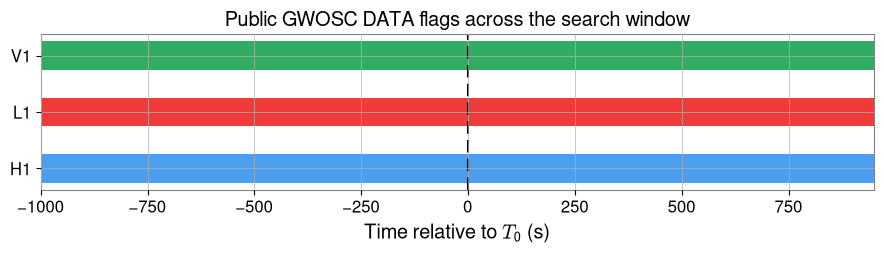
Query and cache the public GWOSC DATA intervals, then plot them across the search window. These flags describe released usable data, not every engineering observing transition. The query includes 128 s on either side for PSD estimation; TDR later checks the full strain segment and PSD. A failed query means unknown availability, not an offline detector.
# Reuse metadata only when its query interval matches the current settings.
if META_FILE.exists():
    metadata = json.loads(META_FILE.read_text())
else:
    metadata = {"query_start": QUERY_START, "query_stop": QUERY_STOP,
                "retrieved_utc": Time.now().utc.isot, "segments": {}, "urls": {}}
if (metadata["query_start"], metadata["query_stop"]) != (QUERY_START, QUERY_STOP):
    raise RuntimeError("Metadata cache belongs to a different time interval.")
for ifo in IFOS:
    if ifo not in metadata["segments"]:
        try:
            metadata["segments"][ifo] = get_segments(f"{ifo}_DATA", QUERY_START, QUERY_STOP)
        except Exception as exc:
            raise RuntimeError(f"Could not query {ifo}_DATA; availability is unknown, not offline.") from exc
META_FILE.write_text(json.dumps(metadata, indent=2))
segments = metadata["segments"]
print("Metadata retrieved (UTC):", metadata["retrieved_utc"])
display(pd.DataFrame([{"IFO": ifo, "DATA intervals (GPS)": segments[ifo]} for ifo in IFOS]))

# Clip each DATA interval to the requested window and plot offsets from T0.
ifo_colors = {"H1": "#4C9FEF", "L1": "#F03B3B", "V1": "#30AD63"}
fig, ax = plt.subplots(figsize=(9, 2.7))
for row, ifo in enumerate(IFOS):
    for start, stop in segments[ifo]:
        left, right = max(start, WINDOW_START), min(stop, WINDOW_END)
        if right > left:
            ax.broken_barh([(left - T0, right - left)], (row - .25, .5), facecolors=ifo_colors[ifo])
ax.axvline(0, color="black", linestyle=(0, (6, 3)), label=r"$T_0$")
plot_left, plot_right = (T_START, T_END) if T_START < T_END else (T_START - .5, T_END + .5)
ax.set(xlim=(plot_left, plot_right), yticks=range(len(IFOS)), yticklabels=IFOS,
       xlabel=r"Time relative to $T_0$ (s)", title="Public GWOSC DATA flags across the search window")
fig.tight_layout()
display(fig)
plt.close(fig)
Metadata retrieved (UTC): 2026-10-21T21:03:06.463
| IFO | DATA intervals (GPS) | |
|---|---|---|
| 0 | H1 | [(1266907203, 1266909410)] |
| 1 | L1 | [(1266907203, 1266909410)] |
| 2 | V1 | [(1266907203, 1266909410)] |
3.5 Evaluation times#
The grid uses multiples of SCAN_STEP anchored at \(T_0\), plus the exact T_START
and T_END. It sorts and removes duplicates; endpoints are never rounded.
Zero is included when it falls inside the window.
For example, \([-100,70.5]\) s with a 32 s step gives
[-100, -96, -64, -32, 0, 32, 64, 70.5].
The current \([-1000,950]\) s window with a 1024 s step gives three centers.
These are evaluation times, not disjoint strain segments.
# Use the production grid so exact endpoints and the T0 anchor are preserved.
offsets = _build_offsets(scan_start=T_START, scan_end=T_END, scan_step=SCAN_STEP)
centers = T0 + np.asarray(offsets)
scan_table = pd.DataFrame({
    "offset_s": offsets,
    "GW_time_UTC": Time(centers, format="gps").utc.isot,
    "folder": [_offset_label(offset) for offset in offsets],
})
print(f"Number of evaluation times: {len(offsets)}")
print("Offsets (s):", offsets)
print("Actual consecutive spacings (s):", np.diff(offsets).tolist())
assert offsets[0] == T_START and offsets[-1] == T_END
assert all(T_START <= offset <= T_END for offset in offsets)
display(scan_table)
Number of evaluation times: 3
Offsets (s): [-1000.0, 0.0, 950.0]
Actual consecutive spacings (s): [1000.0, 950.0]
| offset_s | GW_time_UTC | folder | |
|---|---|---|---|
| 0 | -1000.0 | 2020-02-28T06:41:53.806 | scan_t0m1000 |
| 1 | 0.0 | 2020-02-28T06:58:33.806 | scan_t0p0000 |
| 2 | 950.0 | 2020-02-28T07:14:23.806 | scan_t0p0950 |
# True means the DATA flag is active at that center; full-segment checks come later.
availability_rows = []
for offset, center in zip(offsets, centers):
    row = {"Offset (s)": offset}
    for ifo in IFOS:
        row[ifo] = any(start <= center < stop for start, stop in segments[ifo])
    availability_rows.append(row)
availability_table = pd.DataFrame(availability_rows)
display(availability_table.style.hide(axis="index"))
| Offset (s) | H1 | L1 | V1 |
|---|---|---|---|
| -1000.000000 | True | True | True |
| 0.000000 | True | True | True |
| 950.000000 | True | True | True |
3.6 Strain downloads#
List the unique files covering the search window and its PSD padding, then download
missing files with tqdm progress bars. Each center reads its own 256 s segment from
this shared cache. Multiple centers can reuse one file; prefetch computes no PSD or \(D_{90}\).
# Cache file URLs and list each file once per detector.
download_rows = []
for ifo in IFOS:
    if ifo not in metadata["urls"]:
        metadata["urls"][ifo] = get_urls(ifo, QUERY_START, QUERY_STOP, sample_rate=4096, format="hdf5")
    for url in dict.fromkeys(metadata["urls"][ifo]):
        name = url.rsplit("/", 1)[-1]
        download_rows.append({"IFO": ifo, "file": name, "already_cached": (CACHE_DIR / name).is_file(), "url": url})
META_FILE.write_text(json.dumps(metadata, indent=2))
download_plan = pd.DataFrame(download_rows, columns=["IFO", "file", "already_cached", "url"])
display(download_plan.drop(columns="url"))
print("Unique strain files:", len(download_plan), "| evaluation centers:", len(offsets))
print("Shared strain cache:", CACHE_DIR)
| IFO | file | already_cached | |
|---|---|---|---|
| 0 | H1 | H-H1_GWOSC_O3b_4KHZ_R1-1266905088-4096.hdf5 | False |
| 1 | H1 | H-H1_GWOSC_O3b_4KHZ_R1-1266909184-4096.hdf5 | False |
| 2 | L1 | L-L1_GWOSC_O3b_4KHZ_R1-1266905088-4096.hdf5 | False |
| 3 | L1 | L-L1_GWOSC_O3b_4KHZ_R1-1266909184-4096.hdf5 | False |
| 4 | V1 | V-V1_GWOSC_O3b_4KHZ_R1-1266905088-4096.hdf5 | False |
| 5 | V1 | V-V1_GWOSC_O3b_4KHZ_R1-1266909184-4096.hdf5 | False |
Unique strain files: 6 | evaluation centers: 3
Shared strain cache: /home/idies/workspace/Storage/samueleronchini/persistent/TDR/acme_tutorials/tdr/GRB200228A/gwosc_cache
from urllib.parse import urlparse
from tqdm import tqdm

def prefetch_with_progress(url, cache_dir):
    """Skip cached files; promote a .part download only after it completes."""
    cache_dir = Path(cache_dir)
    cache_dir.mkdir(parents=True, exist_ok=True)
    destination = cache_dir / Path(urlparse(url).path).name
    partial_file = destination.with_name(destination.name + ".part")
    if destination.exists() and destination.stat().st_size > 0:
        print(f"Already cached: {destination.name}")
        return destination

    with requests.get(url, stream=True, timeout=35, headers={"Accept-Encoding": "identity"}) as response:
        response.raise_for_status()
        total = int(response.headers.get("Content-Length", 0)) or None
        with (
            partial_file.open("wb") as output,
            tqdm(total=total, desc=destination.name, unit="B", unit_scale=True,
                 unit_divisor=1024, dynamic_ncols=True, leave=True) as progress,
        ):
            for chunk in response.iter_content(chunk_size=64 * 1024):
                if chunk:
                    output.write(chunk)
                    progress.update(len(chunk))

    # Never rename a known incomplete transfer as a finished cache file.
    if total is not None and partial_file.stat().st_size != total:
        raise IOError(f"Incomplete download: {destination.name}")
    partial_file.replace(destination)
    return destination

if DOWNLOAD_STRAIN:
    for row in download_rows:
        prefetch_with_progress(row["url"], CACHE_DIR)
    print("Strain prefetch complete. No D90 calculations have run yet.")
else:
    print("Prefetch skipped. Use this setting only with prepared completed results, or an already populated cache.")
H-H1_GWOSC_O3b_4KHZ_R1-1266905088-4096.hdf5: 100%|██████████| 123M/123M [00:12<00:00, 10.1MB/s]
H-H1_GWOSC_O3b_4KHZ_R1-1266909184-4096.hdf5: 100%|██████████| 123M/123M [00:09<00:00, 13.8MB/s]
L-L1_GWOSC_O3b_4KHZ_R1-1266905088-4096.hdf5: 100%|██████████| 123M/123M [00:05<00:00, 22.7MB/s]
L-L1_GWOSC_O3b_4KHZ_R1-1266909184-4096.hdf5: 100%|██████████| 123M/123M [00:09<00:00, 13.6MB/s]
V-V1_GWOSC_O3b_4KHZ_R1-1266905088-4096.hdf5: 100%|██████████| 124M/124M [00:08<00:00, 15.4MB/s]
V-V1_GWOSC_O3b_4KHZ_R1-1266909184-4096.hdf5: 100%|██████████| 77.8M/77.8M [00:16<00:00, 5.01MB/s]
Strain prefetch complete. No D90 calculations have run yet.
Results directory#
Use the validated local map, if supplied. A hash of the analysis settings and map content identifies the results folder, keeping different configurations separate.
# Include map content in the run ID so replacing the FITS file changes the results folder.
skymap_file = LOCAL_SKYMAP if USE_SKYMAP else None
settings = dict(
    event=event["name"], t0_gps=T0, ra_deg=event["ra_deg"], dec_deg=event["dec_deg"],
    scan_start=T_START, scan_end=T_END, scan_step=SCAN_STEP,
    iota_min=IOTA_MIN_DEG, iota_max=IOTA_MAX_DEG, snr_threshold=SNR_THRESHOLD, snr_type=SNR_TYPE,
    skymap_sha256=hashlib.sha256(skymap_file.read_bytes()).hexdigest() if skymap_file is not None else None,
)
run_id = hashlib.sha256(json.dumps(settings, sort_keys=True).encode()).hexdigest()[:12]
OUTPUT_DIR = EVENT_DIR / "time_evolution" / run_id
OUTPUT_DIR.mkdir(parents=True, exist_ok=True)
print("Results directory:", OUTPUT_DIR)
Results directory: /home/idies/workspace/Storage/samueleronchini/persistent/TDR/acme_tutorials/tdr/GRB200228A/time_evolution/3d7b0530bbe5
3.7 Run the scan#
run_grb() repeats the single-time calculation at each center, checking strain and PSDs
and saving separate results. The outer loop does not change the waveform or \(D_{90}\) algorithm.
Matching completed results are reused unless FORCE_RECOMPUTE=True.
For the live exercise, predownload the strain; a finer scan can be run afterward.
# Reuse only matching results with the requested centers and no failed bins.
summary_file = OUTPUT_DIR / "scan_summary.json"
settings_file = OUTPUT_DIR / "tutorial_settings.json"
can_reuse = summary_file.exists() and settings_file.exists() and not FORCE_RECOMPUTE
if can_reuse:
    if json.loads(settings_file.read_text()) != settings:
        raise RuntimeError("Existing results have different settings.")
    summary = json.loads(summary_file.read_text())
    if [item["offset_s"] for item in summary["bins"]] != offsets or any(item["status"] == "failed" for item in summary["bins"]):
        raise RuntimeError("Existing scan is incomplete/failed; inspect its log before recomputing.")
    print("Reusing the matching completed scan:", OUTPUT_DIR)
elif RUN_TDR:
    settings_file.write_text(json.dumps(settings, indent=2))
    started = time.monotonic()
    summary = run_grb(
        grb_name=event["name"], t0=event["t0_utc"], output_dir=OUTPUT_DIR,
        ra=event["ra_deg"], dec=event["dec_deg"], skymap_file=skymap_file,
        scan_start=T_START, scan_end=T_END, scan_step=SCAN_STEP,
        iota_min=IOTA_MIN_DEG, iota_max=IOTA_MAX_DEG,
        snr_threshold=SNR_THRESHOLD, snr_type=SNR_TYPE, cache_dir=CACHE_DIR,
    )
    print(f"Scan finished in {(time.monotonic()-started)/60:.1f} min")
else:
    raise FileNotFoundError("No matching completed scan. Set RUN_TDR=True or restore the instructor's matching prepared run.")

# These are the detectors accepted by TDR after the strain and PSD checks.
display(pd.DataFrame([
    {"offset_s": item["offset_s"], "folder": item["scan_name"], "status": item["status"],
     "IFOs actually used": ",".join(item.get("online_ifos") or []) or "none"}
    for item in summary["bins"]
]))
EVENT RUN = O3b
USING GWOSC STRAIN SAMPLE RATE: 4096 Hz
USING SNR TYPE: matched_filter
USING SNR THRESHOLD: 10
USING INCLINATION PRIOR(S):
  0.0 deg <= iota <= 90.0 deg
USING GWOSC CACHE DIR: /home/idies/workspace/Storage/samueleronchini/persistent/TDR/acme_tutorials/tdr/GRB200228A/gwosc_cache
RUNNING 3 SCAN BIN(S): [-1000.0, 0.0, 950.0]
[scan_t0m1000] START at t=1266907331.806
Data H-H1_GWOSC_O3b_4KHZ_R1-1266905088-4096.hdf5 already present in cache. Skipping download.
Data L-L1_GWOSC_O3b_4KHZ_R1-1266905088-4096.hdf5 already present in cache. Skipping download.
Data V-V1_GWOSC_O3b_4KHZ_R1-1266905088-4096.hdf5 already present in cache. Skipping download.
IFOs with available strain data: H1,L1,V1
IFOs used in the analysis:      H1,L1,V1
setting the output map dtype to [dtype('float64')]
INFO:targ_range:scan_t0m1000: finished compute_range
INFO:targ_range:scan_t0m1000: starting plot_final
INFO:targ_range:scan_t0m1000: finished plot_final
INFO:targ_range:scan_t0m1000: completed analysis
[scan_t0m1000] DONE in 76.19 s (1.27 min)
[scan_t0p0000] START at t=1266908331.806
INFO:targ_range:scan_t0p0000: loading GWOSC strain with 3 worker(s)
Data H-H1_GWOSC_O3b_4KHZ_R1-1266905088-4096.hdf5 already present in cache. Skipping download.
Data L-L1_GWOSC_O3b_4KHZ_R1-1266905088-4096.hdf5 already present in cache. Skipping download.
Data V-V1_GWOSC_O3b_4KHZ_R1-1266905088-4096.hdf5 already present in cache. Skipping download.
INFO:targ_range:scan_t0p0000: run=O3b ifo=L1 channel=L1:DCS-CALIB_STRAIN_CLEAN_SUB60HZ_C01 frame_type=L1_HOFT_CLEAN_SUB60HZ_C01 sample_rate=4096 strain usable from ['/home/idies/workspace/Storage/samueleronchini/persistent/TDR/acme_tutorials/tdr/GRB200228A/gwosc_cache/L-L1_GWOSC_O3b_4KHZ_R1-1266905088-4096.hdf5']
INFO:targ_range:scan_t0p0000: run=O3b ifo=H1 channel=H1:DCS-CALIB_STRAIN_CLEAN_SUB60HZ_C01 frame_type=H1_HOFT_CLEAN_SUB60HZ_C01 sample_rate=4096 strain usable from ['/home/idies/workspace/Storage/samueleronchini/persistent/TDR/acme_tutorials/tdr/GRB200228A/gwosc_cache/H-H1_GWOSC_O3b_4KHZ_R1-1266905088-4096.hdf5']
INFO:targ_range:scan_t0p0000: run=O3b ifo=V1 channel=V1:Hrec_hoft_16384Hz frame_type=V1Online sample_rate=4096 strain usable from ['/home/idies/workspace/Storage/samueleronchini/persistent/TDR/acme_tutorials/tdr/GRB200228A/gwosc_cache/V-V1_GWOSC_O3b_4KHZ_R1-1266905088-4096.hdf5']
INFO:targ_range:scan_t0p0000: building PSDs for ['L1', 'H1', 'V1']
INFO:targ_range:scan_t0p0000: starting PSD for H1
INFO:targ_range:scan_t0p0000: finished PSD for H1 -> /home/idies/workspace/Storage/samueleronchini/persistent/TDR/acme_tutorials/tdr/GRB200228A/time_evolution/3d7b0530bbe5/scan_t0p0000/h1_psd.txt in 2.94 s
INFO:targ_range:scan_t0p0000: starting PSD for L1
INFO:targ_range:scan_t0p0000: finished PSD for L1 -> /home/idies/workspace/Storage/samueleronchini/persistent/TDR/acme_tutorials/tdr/GRB200228A/time_evolution/3d7b0530bbe5/scan_t0p0000/l1_psd.txt in 2.93 s
INFO:targ_range:scan_t0p0000: starting PSD for V1
INFO:targ_range:scan_t0p0000: finished PSD for V1 -> /home/idies/workspace/Storage/samueleronchini/persistent/TDR/acme_tutorials/tdr/GRB200228A/time_evolution/3d7b0530bbe5/scan_t0p0000/v1_psd.txt in 2.92 s
IFOs with available strain data: H1,L1,V1
IFOs used in the analysis:      H1,L1,V1
INFO:targ_range:IFOs with available strain data: H1,L1,V1 | IFOs used in the analysis:      H1,L1,V1
INFO:targ_range:scan_t0p0000: final usable IFOs = ['H1', 'L1', 'V1']
INFO:targ_range:scan_t0p0000: IFO status = {'H1': {'strain_available': True, 'psd_ok': True, 'usable': True, 'network_failed': False, 'reason': 'strain complete and PSD valid'}, 'L1': {'strain_available': True, 'psd_ok': True, 'usable': True, 'network_failed': False, 'reason': 'strain complete and PSD valid'}, 'V1': {'strain_available': True, 'psd_ok': True, 'usable': True, 'network_failed': False, 'reason': 'strain complete and PSD valid'}}
INFO:targ_range:scan_t0p0000: starting plot_psd
INFO:targ_range:scan_t0p0000: finished plot_psd
INFO:targ_range:scan_t0p0000: starting injections and pycbc_optimal_snr
INFO:targ_range:scan_t0p0000: starting pycbc_optimal_snr for bns m1=1 m2=1
INFO:targ_range:scan_t0p0000: finished pycbc_optimal_snr for bns m1=1 m2=1 in 4.78 s
INFO:targ_range:scan_t0p0000: starting pycbc_optimal_snr for bns m1=1.4 m2=1.4
INFO:targ_range:scan_t0p0000: finished pycbc_optimal_snr for bns m1=1.4 m2=1.4 in 3.44 s
INFO:targ_range:scan_t0p0000: starting pycbc_optimal_snr for bns m1=2.0 m2=2.0
INFO:targ_range:scan_t0p0000: finished pycbc_optimal_snr for bns m1=2.0 m2=2.0 in 2.97 s
INFO:targ_range:scan_t0p0000: starting pycbc_optimal_snr for nsbh_SFHo m1=5 m2=1
INFO:targ_range:scan_t0p0000: finished pycbc_optimal_snr for nsbh_SFHo m1=5 m2=1 in 2.86 s
INFO:targ_range:scan_t0p0000: starting pycbc_optimal_snr for nsbh_DD2 m1=5 m2=1
INFO:targ_range:scan_t0p0000: finished pycbc_optimal_snr for nsbh_DD2 m1=5 m2=1 in 2.85 s
INFO:targ_range:scan_t0p0000: starting pycbc_optimal_snr for nsbh_SFHo m1=10 m2=1.4
INFO:targ_range:scan_t0p0000: finished pycbc_optimal_snr for nsbh_SFHo m1=10 m2=1.4 in 2.61 s
INFO:targ_range:scan_t0p0000: starting pycbc_optimal_snr for nsbh_DD2 m1=10 m2=1.4
INFO:targ_range:scan_t0p0000: finished pycbc_optimal_snr for nsbh_DD2 m1=10 m2=1.4 in 2.64 s
INFO:targ_range:scan_t0p0000: starting pycbc_optimal_snr for nsbh_SFHo m1=20 m2=2.0
INFO:targ_range:scan_t0p0000: finished pycbc_optimal_snr for nsbh_SFHo m1=20 m2=2.0 in 2.53 s
INFO:targ_range:scan_t0p0000: starting pycbc_optimal_snr for nsbh_DD2 m1=20 m2=2.0
INFO:targ_range:scan_t0p0000: finished pycbc_optimal_snr for nsbh_DD2 m1=20 m2=2.0 in 2.54 s
INFO:targ_range:scan_t0p0000: starting compute_map
WARNING:healpy:setting the output map dtype to [dtype('float64')]
INFO:targ_range:scan_t0p0000: finished compute_map
INFO:targ_range:scan_t0p0000: starting compute_range
INFO:targ_range:scan_t0p0000: finished compute_range
INFO:targ_range:scan_t0p0000: starting plot_final
INFO:targ_range:scan_t0p0000: finished plot_final
INFO:targ_range:scan_t0p0000: completed analysis
[scan_t0p0000] DONE in 75.29 s (1.25 min)
[scan_t0p0950] START at t=1266909281.806
INFO:targ_range:scan_t0p0950: loading GWOSC strain with 3 worker(s)
Data L-L1_GWOSC_O3b_4KHZ_R1-1266905088-4096.hdf5 already present in cache. Skipping download.Data H-H1_GWOSC_O3b_4KHZ_R1-1266905088-4096.hdf5 already present in cache. Skipping download.

Data V-V1_GWOSC_O3b_4KHZ_R1-1266905088-4096.hdf5 already present in cache. Skipping download.
Data L-L1_GWOSC_O3b_4KHZ_R1-1266909184-4096.hdf5 already present in cache. Skipping download.
Data V-V1_GWOSC_O3b_4KHZ_R1-1266909184-4096.hdf5 already present in cache. Skipping download.
Data H-H1_GWOSC_O3b_4KHZ_R1-1266909184-4096.hdf5 already present in cache. Skipping download.
INFO:targ_range:scan_t0p0950: run=O3b ifo=L1 channel=L1:DCS-CALIB_STRAIN_CLEAN_SUB60HZ_C01 frame_type=L1_HOFT_CLEAN_SUB60HZ_C01 sample_rate=4096 strain usable from ['/home/idies/workspace/Storage/samueleronchini/persistent/TDR/acme_tutorials/tdr/GRB200228A/gwosc_cache/L-L1_GWOSC_O3b_4KHZ_R1-1266905088-4096.hdf5', '/home/idies/workspace/Storage/samueleronchini/persistent/TDR/acme_tutorials/tdr/GRB200228A/gwosc_cache/L-L1_GWOSC_O3b_4KHZ_R1-1266909184-4096.hdf5']
INFO:targ_range:scan_t0p0950: run=O3b ifo=V1 channel=V1:Hrec_hoft_16384Hz frame_type=V1Online sample_rate=4096 strain usable from ['/home/idies/workspace/Storage/samueleronchini/persistent/TDR/acme_tutorials/tdr/GRB200228A/gwosc_cache/V-V1_GWOSC_O3b_4KHZ_R1-1266905088-4096.hdf5', '/home/idies/workspace/Storage/samueleronchini/persistent/TDR/acme_tutorials/tdr/GRB200228A/gwosc_cache/V-V1_GWOSC_O3b_4KHZ_R1-1266909184-4096.hdf5']
INFO:targ_range:scan_t0p0950: run=O3b ifo=H1 channel=H1:DCS-CALIB_STRAIN_CLEAN_SUB60HZ_C01 frame_type=H1_HOFT_CLEAN_SUB60HZ_C01 sample_rate=4096 strain usable from ['/home/idies/workspace/Storage/samueleronchini/persistent/TDR/acme_tutorials/tdr/GRB200228A/gwosc_cache/H-H1_GWOSC_O3b_4KHZ_R1-1266905088-4096.hdf5', '/home/idies/workspace/Storage/samueleronchini/persistent/TDR/acme_tutorials/tdr/GRB200228A/gwosc_cache/H-H1_GWOSC_O3b_4KHZ_R1-1266909184-4096.hdf5']
INFO:targ_range:scan_t0p0950: building PSDs for ['L1', 'V1', 'H1']
INFO:targ_range:scan_t0p0950: starting PSD for H1
INFO:targ_range:scan_t0p0950: finished PSD for H1 -> /home/idies/workspace/Storage/samueleronchini/persistent/TDR/acme_tutorials/tdr/GRB200228A/time_evolution/3d7b0530bbe5/scan_t0p0950/h1_psd.txt in 2.93 s
INFO:targ_range:scan_t0p0950: starting PSD for L1
INFO:targ_range:scan_t0p0950: finished PSD for L1 -> /home/idies/workspace/Storage/samueleronchini/persistent/TDR/acme_tutorials/tdr/GRB200228A/time_evolution/3d7b0530bbe5/scan_t0p0950/l1_psd.txt in 2.94 s
INFO:targ_range:scan_t0p0950: starting PSD for V1
INFO:targ_range:scan_t0p0950: finished PSD for V1 -> /home/idies/workspace/Storage/samueleronchini/persistent/TDR/acme_tutorials/tdr/GRB200228A/time_evolution/3d7b0530bbe5/scan_t0p0950/v1_psd.txt in 2.93 s
IFOs with available strain data: H1,L1,V1
IFOs used in the analysis:      H1,L1,V1
INFO:targ_range:IFOs with available strain data: H1,L1,V1 | IFOs used in the analysis:      H1,L1,V1
INFO:targ_range:scan_t0p0950: final usable IFOs = ['H1', 'L1', 'V1']
INFO:targ_range:scan_t0p0950: IFO status = {'H1': {'strain_available': True, 'psd_ok': True, 'usable': True, 'network_failed': False, 'reason': 'strain complete and PSD valid'}, 'L1': {'strain_available': True, 'psd_ok': True, 'usable': True, 'network_failed': False, 'reason': 'strain complete and PSD valid'}, 'V1': {'strain_available': True, 'psd_ok': True, 'usable': True, 'network_failed': False, 'reason': 'strain complete and PSD valid'}}
INFO:targ_range:scan_t0p0950: starting plot_psd
INFO:targ_range:scan_t0p0950: finished plot_psd
INFO:targ_range:scan_t0p0950: starting injections and pycbc_optimal_snr
INFO:targ_range:scan_t0p0950: starting pycbc_optimal_snr for bns m1=1 m2=1
INFO:targ_range:scan_t0p0950: finished pycbc_optimal_snr for bns m1=1 m2=1 in 4.79 s
INFO:targ_range:scan_t0p0950: starting pycbc_optimal_snr for bns m1=1.4 m2=1.4
INFO:targ_range:scan_t0p0950: finished pycbc_optimal_snr for bns m1=1.4 m2=1.4 in 3.48 s
INFO:targ_range:scan_t0p0950: starting pycbc_optimal_snr for bns m1=2.0 m2=2.0
INFO:targ_range:scan_t0p0950: finished pycbc_optimal_snr for bns m1=2.0 m2=2.0 in 2.95 s
INFO:targ_range:scan_t0p0950: starting pycbc_optimal_snr for nsbh_SFHo m1=5 m2=1
INFO:targ_range:scan_t0p0950: finished pycbc_optimal_snr for nsbh_SFHo m1=5 m2=1 in 2.82 s
INFO:targ_range:scan_t0p0950: starting pycbc_optimal_snr for nsbh_DD2 m1=5 m2=1
INFO:targ_range:scan_t0p0950: finished pycbc_optimal_snr for nsbh_DD2 m1=5 m2=1 in 2.90 s
INFO:targ_range:scan_t0p0950: starting pycbc_optimal_snr for nsbh_SFHo m1=10 m2=1.4
INFO:targ_range:scan_t0p0950: finished pycbc_optimal_snr for nsbh_SFHo m1=10 m2=1.4 in 2.63 s
INFO:targ_range:scan_t0p0950: starting pycbc_optimal_snr for nsbh_DD2 m1=10 m2=1.4
INFO:targ_range:scan_t0p0950: finished pycbc_optimal_snr for nsbh_DD2 m1=10 m2=1.4 in 2.63 s
INFO:targ_range:scan_t0p0950: starting pycbc_optimal_snr for nsbh_SFHo m1=20 m2=2.0
INFO:targ_range:scan_t0p0950: finished pycbc_optimal_snr for nsbh_SFHo m1=20 m2=2.0 in 2.50 s
INFO:targ_range:scan_t0p0950: starting pycbc_optimal_snr for nsbh_DD2 m1=20 m2=2.0
INFO:targ_range:scan_t0p0950: finished pycbc_optimal_snr for nsbh_DD2 m1=20 m2=2.0 in 2.52 s
INFO:targ_range:scan_t0p0950: starting compute_map
WARNING:healpy:setting the output map dtype to [dtype('float64')]
INFO:targ_range:scan_t0p0950: finished compute_map
INFO:targ_range:scan_t0p0950: starting compute_range
INFO:targ_range:scan_t0p0950: finished compute_range
INFO:targ_range:scan_t0p0950: starting plot_final
INFO:targ_range:scan_t0p0950: finished plot_final
INFO:targ_range:scan_t0p0950: completed analysis
[scan_t0p0950] DONE in 75.34 s (1.26 min)
ANALYSIS COMPLETE in 227.76 s (3.80 min)
Scan finished in 3.8 min
| offset_s | folder | status | IFOs actually used | |
|---|---|---|---|---|
| 0 | -1000.0 | scan_t0m1000 | complete | H1,L1,V1 |
| 1 | 0.0 | scan_t0p0000 | complete | H1,L1,V1 |
| 2 | 950.0 | scan_t0p0950 | complete | H1,L1,V1 |
3.8 Output folders#
Folders encode the time offset:
Folder |
Candidate GW time |
|---|---|
|
\(T_0-1000\) s |
|
\(T_0\) |
|
\(T_0+950\) s |
Each completed folder contains detector-status information, PSDs, injections, SNR results,
BNS/NSBH JSON files and plots. scan_summary.json lists the bins; gwosc_cache/ is shared.
JSON results include the selected and \(0\)–\(90^\circ\) priors, with one entry if identical.
A center with no usable detector has missing \(D_{90}\), not \(D_{90}=0\).
3.9 Results and time-evolution plot#
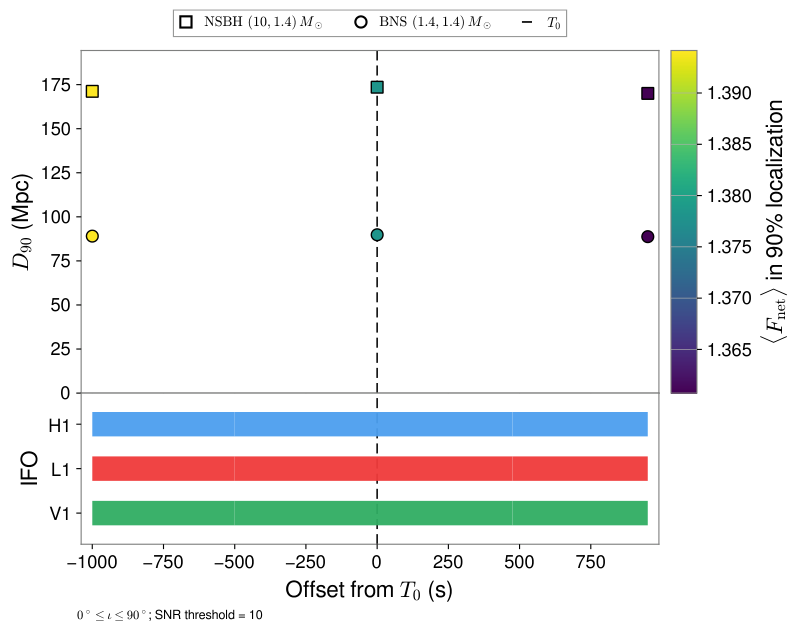
The table reads all stored mass configurations for the selected inclination prior. The saved PDF shows BNS \((1.4,1.4)\,M_\odot\) and NSBH \((10,1.4)\,M_\odot\); the NSBH values follow the code’s EOS averaging.
Colors show the network antenna magnitude at a fixed source position, or its area mean within the map’s 90% credible region. This color statistic does not replace the probability-weighted sky samples used for \(D_{90}\). The lower panel displays detectors used at sampled times; use the earlier DATA timeline for actual flag boundaries.
# Read every mass configuration for the selected prior, keeping antenna factor after network.
rows = load_rows(str(OUTPUT_DIR), summary)
table_rows = []
mass_columns = {"bns": [], "nsbh": []}
for row in rows:
    table_row = {
        "Offset (s)": row["offset_s"], "Status": row["status"],
        "Network": ",".join(row.get("online_ifos") or []) or "none",
        "Antenna factor": (row.get("antenna_factor") or {}).get("network", np.nan),
    }
    if row["status"] == "complete":
        bin_dir = OUTPUT_DIR / row["scan_name"]
        for family in ("bns", "nsbh"):
            results_file = bin_dir / f"results_{family}.json"
            results = json.loads(results_file.read_text())[family]
            for mass_label, entry in results.items():
                masses = mass_label.replace("m1=", "").replace("m2=", "")
                column = f"{family.upper()} ({masses}) D90 (Mpc)"
                if column not in mass_columns[family]:
                    mass_columns[family].append(column)
                value = entry["tdr"][summary["user_prior"]]["D90_Mpc"]
                table_row[column] = np.nan if value is None else float(value)
    table_rows.append(table_row)

columns = ["Offset (s)", "Status", "Network", "Antenna factor", *mass_columns["bns"], *mass_columns["nsbh"]]
evolution = pd.DataFrame(table_rows).reindex(columns=columns)
display(evolution.style.hide(axis="index").format(precision=3, na_rep="—"))

# Preview the saved production PDF; this does not rerun TDR.
pdf_path = OUTPUT_DIR / f"{event['name']}_D90_and_IFO_windows_combined.pdf"
try:
    import fitz
except ImportError:
    print("Open the saved PDF:", pdf_path)
    print("For an inline preview: install pymupdf in this kernel and rerun this cell.")
else:
    with fitz.open(pdf_path) as document:
        display(Image(data=document[0].get_pixmap(matrix=fitz.Matrix(1.4, 1.4), alpha=False).tobytes("png")))
print("Saved production plot:", pdf_path)
| Offset (s) | Status | Network | Antenna factor | BNS (1, 1) D90 (Mpc) | BNS (1.4, 1.4) D90 (Mpc) | BNS (2.0, 2.0) D90 (Mpc) | NSBH (5, 1) D90 (Mpc) | NSBH (10, 1.4) D90 (Mpc) | NSBH (20, 2.0) D90 (Mpc) |
|---|---|---|---|---|---|---|---|---|---|
| -1000.000 | complete | H1,L1,V1 | 1.394 | 68.400 | 89.073 | 119.200 | 114.132 | 171.207 | 265.953 |
| 0.000 | complete | H1,L1,V1 | 1.378 | 68.633 | 89.835 | 120.836 | 116.589 | 173.554 | 268.219 |
| 950.000 | complete | H1,L1,V1 | 1.361 | 66.788 | 88.770 | 118.189 | 113.744 | 170.042 | 263.249 |
/home/idies/miniforge/envs/gw-tdr/lib/python3.11/site-packages/fitz/__init__.py:17: FutureWarning: The `fitz` API is deprecated and will be removed in future. Use `import pymupdf` instead.
  warnings.warn(
Saved production plot: /home/idies/workspace/Storage/samueleronchini/persistent/TDR/acme_tutorials/tdr/GRB200228A/time_evolution/3d7b0530bbe5/GRB200228A_D90_and_IFO_windows_combined.pdf
Compare one time with the sampled range#
Choose an evaluated REFERENCE_OFFSET below. The table compares its \(D_{90}\) with
the sampled minimum and maximum for every mass pair; it does not evaluate a new time.
These extrema describe the sampled centers, not a continuously measured curve.
REFERENCE_OFFSET = -1000.0  # Choose an evaluated offset, e.g. -1000, 0 or 950 s.
selected = evolution.loc[np.isclose(evolution["Offset (s)"], REFERENCE_OFFSET, rtol=0, atol=1e-6)]
if selected.empty:
    available = evolution["Offset (s)"].tolist()
    raise ValueError(f"Offset {REFERENCE_OFFSET:g} s was not evaluated. Choose from: {available}")

# Ignore missing distances when calculating sampled extrema.
comparison = []
for column in mass_columns["bns"] + mass_columns["nsbh"]:
    values = evolution[column].dropna()
    comparison.append({
        "System": column.removesuffix(" D90 (Mpc)"),
        f"D90 at {REFERENCE_OFFSET:g} s (Mpc)": selected.iloc[0][column],
        "Sampled min (Mpc)": values.min(), "Sampled max (Mpc)": values.max(),
        "Valid centers / requested": f"{len(values)}/{len(offsets)}",
    })
display(pd.DataFrame(comparison).style.hide(axis="index").format(precision=3, na_rep="—"))
| System | D90 at -1000 s (Mpc) | Sampled min (Mpc) | Sampled max (Mpc) | Valid centers / requested |
|---|---|---|---|---|
| BNS (1, 1) | 68.400 | 66.788 | 68.633 | 3/3 |
| BNS (1.4, 1.4) | 89.073 | 88.770 | 89.835 | 3/3 |
| BNS (2.0, 2.0) | 119.200 | 118.189 | 120.836 | 3/3 |
| NSBH (5, 1) | 114.132 | 113.744 | 116.589 | 3/3 |
| NSBH (10, 1.4) | 171.207 | 170.042 | 173.554 | 3/3 |
| NSBH (20, 2.0) | 265.953 | 263.249 | 268.219 | 3/3 |
3.10 Optional: compare detector noise#
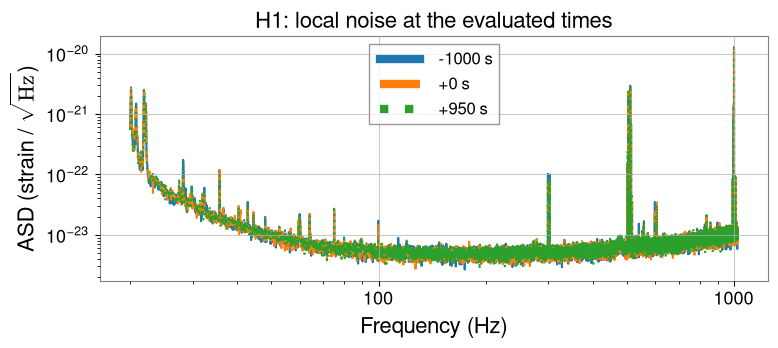
Choose PSD_IFO and overlay its saved amplitude spectral densities at the evaluated times.
Missing PSD files are skipped. Explicit dash patterns distinguish the curves in the legend.
PSD_IFO = "H1"  # Choose H1, L1 or V1.
fig, ax = plt.subplots(figsize=(8, 3.7))
styles = ["solid", (0, (6, 3)), (0, (1, 2))]
for index, item in enumerate(summary["bins"]):
    path = OUTPUT_DIR / item["scan_name"] / f"{PSD_IFO.lower()}_psd.txt"
    if path.exists():
        frequency, psd = np.loadtxt(path).T
        keep = (frequency >= 20) & (frequency <= 1024)
        ax.loglog(frequency[keep], np.sqrt(psd[keep]), linestyle=styles[index % len(styles)],
                  label=f"{item['offset_s']:+g} s", linewidth=1.5)
ax.set(xlabel="Frequency (Hz)", ylabel=r"ASD (strain / $\sqrt{\rm Hz}$)",
       title=f"{PSD_IFO}: local noise at the evaluated times")
if ax.lines:
    ax.legend(handlelength=3)
else:
    ax.text(.5, .5, "No PSD files for this detector", transform=ax.transAxes, ha="center")
fig.tight_layout()
fig.savefig(OUTPUT_DIR / "tutorial_psd_comparison.png", dpi=140)
display(fig)
plt.close(fig)
Interpreting an unknown-delay window#
Changes in \(D_{90}\) can reflect detector availability, PSDs, antenna response and Monte Carlo sampling. A single exclusion distance for an unknown merger time also requires a delay prior: average the efficiencies, \(\bar\epsilon(D)=\int\epsilon(D,t)p(t)\,dt\), including detector gaps, then find the 90% crossing. Do not simply average \(D_{90}(t)\).
References: TDR code, GWOSC DATA definition, timeline client, O4b release.